
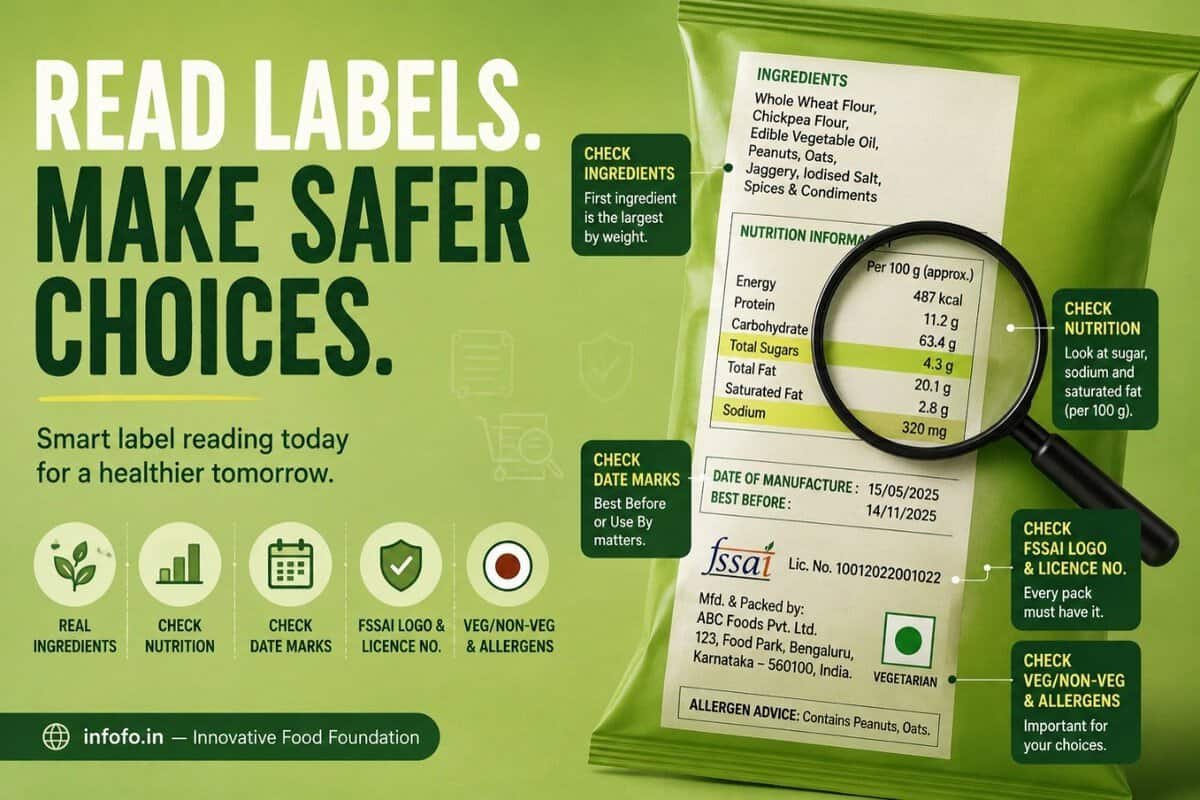
Learning how to read a food label doesn’t require a nutrition degree. You just need to know where to look on the pack and what a few key words mean. In India, FSSAI sets the rules for what must appear on labels , so “reading” a label is really just knowing those rules in plain language.
Why this matters (beyond “eat healthy”)
This isn’t just about calories. In 2024–25, 7,705 complaints related to food adulteration and food safety were registered through the Food Safety Connect platform, of which 5,952 were resolved, according to data shared by the government in Parliament.
Recent food-testing data and food-safety complaints highlight why consumers should pay attention to product information rather than relying only on front-of-pack claims. A failed food sample does not necessarily mean that a product is poisonous; non-compliance can involve safety, quality, adulteration or labelling issues.
The 60-second label check
Four things to check, in order. Front, back, dates, and the fine print.
1. Skip the front, flip to the ingredients
Front-of-pack words like “healthy,” “natural,” “no added sugar,” or “protein-rich” are marketing claims, not guarantees. Use the front only to identify the product, then flip it over.
FSSAI requires ingredients to be listed in descending order by weight. That means the ingredients at the beginning of the list make up the largest proportions of the product.
- If sugar, refined flour, or a syrup shows up in the first 2-3 ingredients, that’s mostly what the product is regardless of what the front says.
- Watch for added sugars listed under different names, such as sucrose, glucose, fructose, maltose, dextrose or jaggery powder. If several sugar ingredients appear near the beginning of the list, the product is likely to be high in added sugars. This is a practical reading tip, not a legal threshold.
- A short ingredient list isn’t automatically a healthy one, so don’t stop there, check the numbers next.
2. Check the nutrition panel : compare per 100g, not just per serving
FSSAI requires nutritional information to be provided per 100g or 100ml, or per single-consumption pack, along with serving-related information. For comparing similar products, the per-100g/100ml figures are usually the most useful starting point. Focus on three things
- Sugar: Compare the amount per 100 g between products. Do not treat “low” or “high” as a universal legal classification unless the product label or applicable regulation specifically uses that claim.
- Sodium: Pay attention to this if you’re trying to limit sodium intake. Sodium can come from added salt as well as sodium-containing ingredients and additives.
- Protein & fibre: Higher amounts may contribute to fullness, but individual nutritional needs vary.
Serving sizes can differ between products, so comparing the per-100g/100ml figures can give you a more consistent basis for comparison.
3. Check the date and storage instructions
A “best before” date generally relates to the period during which the product is expected to retain its intended quality. An “expiry/use by” date is a safety-related date after which the food should not be consumed. Always follow the instructions on the package and pay attention to storage conditions.
If a product requires refrigeration but has been stored improperly, don’t assume it is safe simply because the printed date has not passed.
4. Look for the mandatory declarations
Packaged food labels generally carry the FSSAI logo and licence number, along with the name and address of the responsible food business operator.
- Confirm the logo is there, and note the 14-digit licence number .Keep the licence number handy if you need to raise a complaint or identify the food business responsible for the product. For more information check out our blog From Plate to Policy: A Guide to Reporting Food Safety Breaches
- Check the vegetarian or non-vegetarian symbol. Vegetarian products use the prescribed green symbol, while non-vegetarian products use the prescribed brown symbol.
- If you have a food allergy, check the allergen declaration for ingredients relevant to you, such as milk, eggs, peanuts, tree nuts, soy, fish or gluten-containing cereals.
The one-minute habit
Before it goes in your basket, ask:
- What are the first three ingredients?
- How much sugar and sodium per 100g?
- Any real protein or fibre?
- Sealed and stored properly?
- Dates, FSSAI number, symbols, allergens all checked?
That’s it. You do not need to understand every additive or calculate every calorie. Start with the first few ingredients, compare the per-100-g nutrition values and check the dates and mandatory declarations.
That simple habit can help you look past the front-of-pack promises and make a more informed choice.
This article is for general consumer information only and is not nutrition, medical or legal advice. Food-labelling requirements may vary by product category and may change over time. For specific dietary or regulatory questions, consult a qualified professional or refer to the current official FSSAI regulations